Iris recognition and classification methods
DOI:
https://doi.org/10.24036/jtein.v7i1.829Keywords:
Iris recognition; Gabor Wavelet; K-Nearest Neighbor; CASIA; Biometric.Abstract
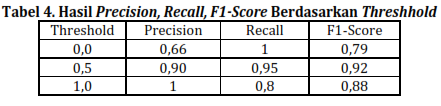
Conventional authentication methods such as passwords and Personal Identification Numbers (PINs) have proven to be vulnerable to misuse and data breaches, highlighting the urgent need for more reliable identity verification systems. Biometric-based authentication, particularly iris recognition, has emerged as a promising solution due to the unique and physiologically stable nature of iris patterns throughout a person's lifetime. However, previous studies in iris recognition have reported limited accuracy and lacked comprehensive evaluation using metrics such as Precision, Recall, and F1-Score. This study designed and implemented an iris recognition system using Gabor Wavelet as the feature extraction method combined with the K-Nearest Neighbor (K-NN) classification algorithm. The dataset was obtained from the CASIA Iris Database, consisting of 100 images covering 20 identity classes, of which 20 images were used as test data. The system pipeline comprised iris segmentation, normalization, feature extraction using Gabor Wavelet, and classification using K-NN with K=1 and Euclidean distance. System performance was evaluated using accuracy, Precision, Recall, and F1-Score metrics across multiple threshold values. The experimental results showed that the proposed system achieved an accuracy of 95%. At a threshold of 0.5, the system produced the best overall performance with a Precision of 0.90, Recall of 0.95, and F1-Score of 0.92. These findings confirmed that the combination of Gabor Wavelet and K-NN was effective for biometric-based iris recognition systems.
Downloads
References
[2] R. Mukhaiyar and R. Safitri, “Implementation of artificial neural network: Back propagation method on face recognition system,” 2019 16th International Conference on Quality in Research, QIR 2019 - International Symposium on Electrical and Computer Engineering, pp. 1–5, 2019, doi: 10.1109/QIR.2019.8898276.
[3] M. Juliani, “Keamanan Data Pribadi di Era Digital: Tanggung Jawab Siapa,” Jurnal Intelek Insan Cendikia, vol. 3, no. 4, pp. 2793–2801, 2026.
[4] A. Shalsabila and R. Mukhaiyar, “Perancangan Alat Pendeteksi Iris Mata Menggunakan Metode Wavelet Filter,” JTEV (Jurnal Teknik Elektro dan Vokasional), vol. 8, no. 2, p. 433, 2022, doi: 10.24036/jtev.v8i2.118360.
[5] R. Mukhaiyar, “Analysis of Galton-Henry classification method for fingerprint database FVC 2002 and 2004,” International Journal of GEOMATE, vol. 13, no. 40, pp. 118–123, 2017, doi: 10.21660/2017.40.92748.
[6] F. E. Alfian, G. Pasek, S. Wijaya, and F. Bimantoro, “Identifikasi Iris Mata Menggunakan Metode Wavelet Daubechies dan K-Nearest Neighbor,” JTIKA, vol. 2, no. 1, pp. 1–10, 2020.
[7] S. Bhatt, J. S. Sehrawat, and V. Gupta, “A systematic review of iris biometrics in forensic science: applications and challenges,” Egypt. J. Forensic Sci., vol. 15, no. 1, Dec. 2025, doi: 10.1186/s41935-025-00431-7.
[8] S. Kumari, A. Bhatanagar, A. Agarwal, A. Kakkar, and N. Gupta, “Decoding The Twin Code?: Exploring Multimodal Biometrics in Identical Twin Differentiation- A Systematic Review,” J. Neonatal Surg., vol. 14, no. 8, pp. 980–989, 2025.
[9] E. Yuliansyah, I. R. Magdalena, and Estananto, “Sistem Identifikasi Iris Mata Dengan Metode Independent Component Analysis dan Klasifikasi K-Nearest Neighbor,” e-Proceeding of Engineering, vol. 4, no. 2, pp. 1810–1815, 2017.
[10] A. F. Kurniawan, R. Wulanningrum, and D. Swanjaya, “Pengenalan Iris Mata Menggunakan Metode Convolutional Neural Network,” Seminar Nasional Inovasi Teknologi, pp. 344–349, 2021.
[11] F. J. Pontoh, F. Xaverius Senduk, and I. E. G. Pondaag, “Aplikasi Pengenalan Iris Mata Menggunakan Metode Hough Transform Dan Gabor Wavelet,” Jurnal Ilmiah Informatika, vol. 9, no. 02, pp. 105–109, 2021, doi: 10.33884/jif.v9i02.4205.
[12] Al-Waisy, H. J. Mohammed, S. Al-Fahdawi, et al., “A proposed biometric authentication hybrid approach using Iris recognition for improving cloud security,” Heliyon, vol. 10, no. 16, e36390, 2024, doi: 10.1016/j.heliyon.2024.e36390.
[13] S. Serte and H. Demirel, “Gabor wavelet-based deep learning for skin lesion classification,” Comput. Biol.Med., vol. 113, 2019, doi: 10.1016/j.compbiomed.2019.103423.
[14] R. Mohammed, S. U. Ahsaan, and H. Kaur, “Iris Recognition based Biometric identification using Neural Networks,” 2021, doi: 10.4108/eai.27-2-2020.2303175.
[15] G. Sugisandhea and T. Handhayani, “Perbandingan Kinerja Knn, Svm, Dan Ann Untuk Memprediksi Level Obesitas,” Jurnal Ilmu Komputer dan Sistem Informasi, vol. 13, no. 2, 2024, doi: 10.24912/jiksi.v13i2.34306.
[16] D. Yunita, “Perbandingan Algoritma K-Nearest Neighbor dan Decision Tree untuk Penentuan Risiko Kredit Kepemilikan Mobil,” J. Inform. Univ. Pamulang, vol. 2, no. 2, p. 103, 2017, doi: 10.32493/informatika.v2i2.1512.
[17] K. K. Purnamasari and N. I. Widiastuti, “Perbandingan Algoritma K-Means Dan K-Nearest Neighbors Pada Sistem Peringkasan Otomatis,” Komputa J. Ilm. Komput. dan Inform., vol. 6, no. 2, pp. 57–66, 2017, doi: 10.34010/komputa.v6i2.2478.
Downloads
Published
How to Cite
Issue
Section
License
Copyright (c) 2026 JTEIN: Jurnal Teknik Elektro Indonesia

This work is licensed under a Creative Commons Attribution 4.0 International License.