Fingerprint Identification System using Hong Approach
DOI:
https://doi.org/10.24036/jtein.v7i2.887Keywords:
Fingerprint Identification, Hong Method, Image Recognition, Biometric, SOCOFing DatasetAbstract
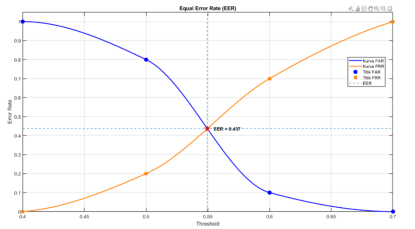
Fingerprint recognition has been widely adopted as a biometric authentication method because it offers a unique and reliable means of verifying identity. However, the accuracy of fingerprint recognition systems depended on the quality of the acquired images, which were often affected by noise, low contrast, and unclear ridge–valley patterns that hindered minutiae extraction. This study addressed that problem by applying the Hong method, which enhanced fingerprint images through normalization, ridge orientation estimation, ridge frequency estimation, and Gabor filtering, prior to minutiae extraction and template matching. The method was implemented in MATLAB R2023b and tested on grayscale fingerprint images from the SOCOFing dataset. Testing was conducted on ten classes of fingerprint data, with recognition accuracy evaluated through identity matching and further assessed using a confusion matrix built from twenty test images, consisting of ten registered and ten unregistered users, across four threshold values. The results showed that the Hong method achieved a recognition accuracy of only 10%, even though eight of ten test images were classified as recognized based on similarity scores exceeding the threshold, indicating that the system was prone to false acceptance at lower thresholds. Analysis of the False Acceptance Rate and False Rejection Rate revealed a trade-off, with the Equal Error Rate occurring at a threshold of 0.5495 and a value of 0.4367. These findings indicated that although the Hong method improved fingerprint image quality, the overall identification performance remained low, and careful threshold selection was required to balance false acceptance and false rejection in fingerprint authentication systems.
Downloads
References
[1] K. Santosh, “Editorial: Current Trends in Image Processing and Pattern Recognition,” Front. Robot. AI, vol. 8, Dec. 2021, doi: 10.3389/frobt.2021.785075.
[2] R. Jayavadivel and P. Prabaharan, “Investigation on automated surveillance monitoring for human identification and recognition using face and iris biometric,” J. Ambient Intell. Humaniz. Comput., vol. 12, no. 11, pp. 10197–10208, Nov. 2021, doi: 10.1007/s12652-020-02787-1.
[3] H. K. Rana, Md. S. Azam, Mst. R. Akhtar, J. M. W. Quinn, and M. A. Moni, “A fast iris recognition system through optimum feature extraction,” PeerJ Comput. Sci., vol. 5, p. e184, Apr. 2019, doi: 10.7717/peerj-cs.184.
[4] J. Liu, Q. Lyu, Q. Wang, and X. Yu, “A digital memories based user authentication scheme with privacy preservation,” PLoS One, vol. 12, no. 11, p. e0186925, Nov. 2017, doi: 10.1371/journal.pone.0186925.
[5] E. McCallister, T. Grance, and K. A. Scarfone, “Guide to protecting the confidentiality of Personally Identifiable Information (PII),” Gaithersburg, MD, 2010. doi: 10.6028/NIST.SP.800-122.
[6] R. Mukhaiyar, “Generating a Cancellable Fingerprint using Matrices Operations and Its Fingerprint Processing Requirements,” Asian Soc. Sci., vol. 14, no. 6, p. 1, May 2018, doi: 10.5539/ass.v14n6p1.
[7] M. Joshi, B. Mazumdar, and S. Dey, “Security Vulnerabilities Against Fingerprint Biometric System,” May 2018, [Online]. Available: http://arxiv.org/abs/1805.07116
[8] A. Jain, L. Hong, and S. Pankanti, “Biometric identification,” IOP Conf. Ser. Mater. Sci. Eng., vol. 363, no. 1, pp. 1–11, 2018, doi: 10.1088/1757-899X/363/1/012005.
[9] Sumijan, Pradani Ayu Widya Purnama, and Syafri Arlis, “Teknologi Biometrik,” 2021.
[10] R. Gupta, M. Khari, D. Gupta, and R. G. Crespo, “Fingerprint image enhancement and reconstruction using the orientation and phase reconstruction,” Inf. Sci. (N. Y)., vol. 530, pp. 201–218, Aug. 2020, doi: 10.1016/j.ins.2020.01.031.
[11] S. Socheat and T. Wang, “Fingerprint Enhancement, Minutiae Extraction and Matching Techniques,” Journal of Computer and Communications, vol. 08, no. 05, pp. 55–74, 2020, doi: 10.4236/jcc.2020.85003.
[12] M. M. Taye, “Theoretical Understanding of Convolutional Neural Network: Concepts, Architectures, Applications, Future Directions,” Computation, vol. 11, no. 3, p. 52, Mar. 2023, doi: 10.3390/computation11030052.
[13] J. A. Alhijaj and R. S. Khudeyer, “Integration of EfficientNetB0 and Machine Learning for Fingerprint Classification,” Informatica, vol. 47, no. 5, May 2023, doi: 10.31449/inf.v47i5.4724.
[14] M. Diarra, A. K. Jean, B. A. Bakary, and K. B. Medard, “Study of Deep Learning Methods f or Fingerprint Recognition,” International Journal of Recent Technology and Engineering (IJRTE), vol. 10, no. 3, pp. 192–197, Sep. 2021, doi: 10.35940/ijrte.C6478.0910321.
[15] R. Mukhaiyar, “CORE-POINT, RIDGE-FREQUENCY, AND RIDGE-ORIENTATION DENSITY ROLES IN SELECTING REGION OF INTEREST OF FINGERPRINT,” International Journal of GEOMATE, vol. 12, no. 30, Feb. 2017, doi: 10.21660/2017.30.tvet015.
[16] A. Kurniawati and R. Mukhaiyar, “Face Recognition Systems: Comparation Point of View between CNN and LBPH Methods,” JTEIN: Jurnal Teknik Elektro Indonesia, vol. 7, no. 1, pp. 156–164, 2026.
[17] H. D. Ulhaq and R. Mukhaiyar, “Iris Recognition and Classification Methods,” JTEIN: Jurnal Teknik Elektro Indonesia, vol. 7, no. 1, pp. 122–129, 2026.
[18] R. Mukhaiyar, “ANALYSIS OF GALTON-HENRY CLASSIFICATION METHOD FOR FINGERPRINT DATABASE FVC 2002 AND 2004,” International Journal of GEOMATE, vol. 13, no. 40, Dec. 2017, doi: 10.21660/2017.40.92748.
Downloads
Published
How to Cite
Issue
Section
License
Copyright (c) 2026 Foni Aysah, Riki Mukhaiyar

This work is licensed under a Creative Commons Attribution 4.0 International License.