Handhled Air Quality Monitor Powered by ESP32 and Li-ion Battery Management for Real-Time Field Inspections
DOI:
https://doi.org/10.24036/jtein.v7i2.913Keywords:
Air quality monitoring, ESP32, Portable device, Li-ion battery management, OLED displayAbstract
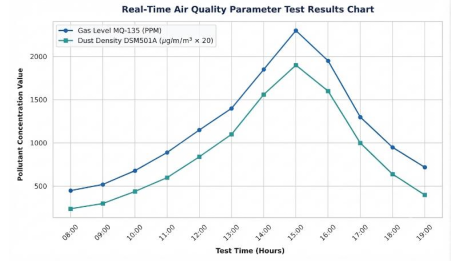
The urgency of this research stems from the pressing need to address the limitations of static air quality monitoring systems, especially given a 30% increase in respiratory complaints among Indonesian students by 2025 due to undetected hazardous pollutants. Employing a prototyping approach, the system integrates an MQ-135 gas sensor outputting raw analog voltage converted to parts per million (PPM), a DSM501A dust sensor outputting pulse width modulation (PWM) low-pulse occupancy ratio converted to micrograms per cubic meter (µg/m3), and an autonomous 18650 Li-ion battery management system with an MT3608 boost converter to ensure voltage stability. Furthermore, it utilizes an SSD1306 OLED display for independent, real-time data visualization without requiring internet connectivity. Field testing of this handheld device was conducted across 3 distinct indoor and outdoor test locations over a period of 3 consecutive days between 08:00 and 19:00 WIB. The air quality status was classified using a threshold-based procedure, categorizing conditions into "GOOD," "MODERATE," or "POOR" based on specific gas concentration and dust density ranges. The results showed significant daily fluctuations, with gas concentrations averaging 1,180 PPM (ranging from 450 to 2,300 PPM) and dust density averaging 44.2 µg/m3 (ranging from 12 to 95 µg/m3). The data demonstrated a clear trend where pollution peaked at 15:00, reaching a "POOR" air quality status during peak mobility hours, before gradually declining to a "GOOD" status by 19:00. Ultimately, this portable solution successfully maps air quality in previously inaccessible blind spots, providing functional monitoring data to help communities mitigate respiratory health risks.
Downloads
References
[1] M. Nei, B. Damanik, and L. Anifah, “Air Pollution Quality Monitor (CO, CO 2 , PM2.5) at Surabaya State University,” Indonesian Journal of Electrical and Electronics Engineering (INAJEEE), vol. 7, no. 1, pp. 12–18, 2024, doi: 10.26740/inajeee.v7n1.
[2] A. Mota, C. Serôdio, A. Briga-Sá, and A. Valente, “Implementation of an Internet of Things Architecture to Monitor Indoor Air Quality: A Case Study During Sleep Periods,” Sensors, vol. 25, no. 6, Mar. 2025, doi: 10.3390/s25061683.
[3] H. Jatnika, M. F. Rifai, and Y. S. Purwanto, “Development of Indoor Air Quality Measuring Device and Application to Support Campus in Post-Covid-19 Pandemic Class Preparation,” International Journal of Social Service and Research, vol. 3, no. 10, pp. 2553–2562, Oct. 2023, doi: 10.46799/ijssr.v3i10.572.
[4] A. L. Dutta, T. Mukherjee, and J. Sinha, “Design and Implementation of a Low-Cost Device to Monitor the Real-Time Presence of CO and CO2 in Ambient Air and Prediction of its Pollution Level using TinyML,” MAPAN, vol. 41, no. 1, pp. 119–129, 2026, doi: 10.1007/s12647-026-00890-w.
[5] F. F. Rahani and H. I. K. Fathurrahman, “Air quality monitoring using multi node slave IoT,” Journal of Soft Computing Exploration, vol. 5, no. 1, pp. 46–54, Mar. 2024, doi: 10.52465/joscex.v5i1.292.
[6] Sudirman. Lumbangaol, R. Siagian, F. Siahaan, and E. Sitinjak, “IOT-Based Pollution and Air Quality Monitoring Equipment with ESP-8266,” European Alliance for Innovation n.o., Aug. 2022. doi: 10.4108/eai.11-10-2021.2319568.
[7] G. I. Drewil and R. J. Al-Bahadili, “Environmental Pollution Monitoring System Based on IoT,” Iraqi Journal of Computers, Communications, Control and Systems Engineering, vol. 22, no. 1, pp. 1–10, Mar. 2022, doi: 10.33103/uot.ijccce.22.1.1.
[8] O. Alsamrai, M. D. Redel-Macias, and M. P. Dorado, “Real-Time Intelligent Monitoring of Outdoor Air Quality in an Urban Environment Using IoT and Machine Learning Algorithms,” Applied Sciences (Switzerland), vol. 15, no. 16, Aug. 2025, doi: 10.3390/app15169088.
[9] A. Stanimirescu, S. Mihai Radu, and S. F. Flavius, “MEASUREMENTS MADE USING DSM501A SENSORS VERSUS MEASUREMENTS MADE BY NATIONAL AIR QUALITY MONITORING NETWORK,” 2020.
[10] O. O. Flores-Cortez, C. O. Pocasangre, F. Arevalo, B. A. Castillo, and L. D. Segovia, “Mobile Air Quality Sensor System for GIS Mapping, Study Case in San Salvador City,” in 2024 IEEE ANDESCON, 2024, pp. 1–6. doi: 10.1109/ANDESCON61840.2024.10755697.
[11] L. M. Easterline, A. A. Z. R. Putri, P. S. Atmaja, A. L. Dewi, and A. Prasetyo, “Smart Air Monitoring with IoT-based MQ-2, MQ-7, MQ-8, and MQ-135 Sensors using NodeMCU ESP32,” in Procedia Computer Science, Elsevier B.V., 2024, pp. 815–824. doi: 10.1016/j.procs.2024.10.308.
[12] M. C. Patil, B. Imarati, S. Lamani, Basavarajeshwari, B. Kinnal, and N. C. Iyer, “Real-Time Air Quality Measurement System Using ESP32,” in ICT: Applications and Social Interfaces, A. Joshi, R. Ragel, M. Mahmud, and S. Kartik, Eds., Singapore: Springer Nature Singapore, 2025, pp. 321–330.
[13] Y. Khawaja et al., “Battery management solutions for li-ion batteries based on artificial intelligence,” Ain Shams Engineering Journal, vol. 14, no. 12, Dec. 2023, doi: 10.1016/j.asej.2023.102213.
[14] N. Nowshin and M. S. Hasan, “Microcontroller Based Environmental Pollution Monitoring System though IoT Implementation,” in 2021 2nd International Conference on Robotics, Electrical and Signal Processing Techniques (ICREST), 2021, pp. 493–498. doi: 10.1109/ICREST51555.2021.9331020.
[15] R. Suganya, L. M. I. L. Joseph, and S. Kollem, “Understanding lithium-ion battery management systems in electric vehicles: Environmental and health impacts, comparative study, and future trends: A review,” Dec. 01, 2024, Elsevier B.V. doi: 10.1016/j.rineng.2024.103047.
[16] A. Perdomo-Campos, I. Vega-González, and J. Ramírez-Beltrán, “ESP32 Based Low-Power and Low-Cost Wireless Sensor Network,” in Proceedings of 19th Latin American Control Congress (LACC 2022), O. Llanes-Santiago, Ed., Cham: Springer International Publishing, 2023, pp. 275–285.
[17] I. U. Mullick, K. A. Faisal, T. I. Nishat, and M. H. Bhuyan, “Portable Air Quality Detector Using DSM501A Dust Sensor and Arduino Uno,” Journal of Engineering Research and Reports, vol. 26, no. 5, pp. 163–174, Apr. 2024, doi: 10.9734/jerr/2024/v26i51143.
[18] A. K. M. A. Habib, M. K. Hasan, G. F. Issa, D. Singh, S. Islam, and T. M. Ghazal, “Lithium-Ion Battery Management System for Electric Vehicles: Constraints, Challenges, and Recommendations,” Mar. 01, 2023, MDPI. doi: 10.3390/batteries9030152.
[19] T. Fleetham and M. S. Weaver, “Phosphorescent OLEDs for Power-Efficient Displays,” in Advanced Display Technology: Next Generation Self-Emitting Displays, I. B. Kang, C. W. Han, and J. K. Jeong, Eds., Singapore: Springer Singapore, 2021, pp. 1–38. doi: 10.1007/978-981-33-6582-7_1.
[20] Daris Alfafa, D. Moraru, and Arief Udhiarto, “A Fabrication of Organic Light Emitting Diodes (OLEDs) using the Lamination method in a Vacuum-Free Environment,” International Journal of Electrical, Computer, and Biomedical Engineering, vol. 1, no. 2, pp. 54–64, Dec. 2023, doi: 10.62146/ijecbe.v1i2.24.
[21] K. D. D. Nelluri et al., “Self-powered sensors and wearables: Energy harvesting with nanomaterials for the IoT era,” Mar. 01, 2026, Elsevier B.V. doi: 10.1016/j.nwnano.2026.100179.
[22] M. Balle, W. Xu, K. F. Darras, and T. C. Wanger, “A Power Management and Control System for Environmental Monitoring Devices,” IEEE Transactions on AgriFood Electronics, vol. 3, no. 1, pp. 134–143, 2025, doi: 10.1109/TAFE.2024.3472493.
[23] H. Liu, H. Fu, L. Sun, C. Lee, and E. M. Yeatman, “Hybrid energy harvesting technology: From materials, structural design, system integration to applications,” Renewable and Sustainable Energy Reviews, vol. 137, p. 110473, 2021, doi: https://doi.org/10.1016/j.rser.2020.110473.
[24] D. H. Yoo and C. H. Moon, “Solution-Processed Organic Light-Emitting Diodes Using a Lamination Method,” Applied Sciences (Switzerland), vol. 14, no. 24, Dec. 2024, doi: 10.3390/app142411671.
[25] K. C. Moon, J. H. Jeon, and K. C. Park, “A Study of Device Parameters Affecting the Current Error Rate in a Low-Temperature Polycrystalline Silicon Thin-Film Transistor Pixel Circuit for Active-Matrix Organic Light-Emitting Diode Display Applications,” Electronics (Switzerland), vol. 13, no. 23, Dec. 2024, doi: 10.3390/electronics13234810.
[26] M. J. C. S. Reis, “Low-Power Embedded Sensor Node for Real-Time Environmental Monitoring with On-Board Machine-Learning Inference,” Sensors, vol. 26, no. 2, Jan. 2026, doi: 10.3390/s26020703.
[27] L. Liu, L. Chen, S. Xu, Y. Xu, and C. Shi, “Design and implementation of intelligent monitoring terminal for distribution room based on edge computing,” Energy Reports, vol. 7, pp. 1131–1138, Nov. 2021, doi: 10.1016/j.egyr.2021.09.154.
[28] M. Ismail and R. Ahmed, “A Comprehensive Review of Cloud-Based Lithium-Ion Battery Management Systems for Electric Vehicle Applications,” 2024, Institute of Electrical and Electronics Engineers Inc. doi: 10.1109/ACCESS.2024.3446880.
[29] L. Wei and qiaoling gao, “Design of a portable IoT environmental monitoring system,” in Other Conferences, 2024. [Online]. Available: https://api.semanticscholar.org/CorpusID:274673196
[30] T. L. Narayana et al., “Advances in real time smart monitoring of environmental parameters using IoT and sensors,” Heliyon, vol. 10, no. 7, Apr. 2024, doi: 10.1016/j.heliyon.2024.e28195.
Downloads
Published
How to Cite
Issue
Section
License
Copyright (c) 2026 Miftakhul Maulidina, Muhammad Nur Habib Maulidan

This work is licensed under a Creative Commons Attribution 4.0 International License.