Analysis of SSD usage for performance improvement on the Asus TUF FX505DU
DOI:
https://doi.org/10.24036/jtein.v7i2.821Keywords:
Solid-state drive, Hard disk drive, Benchmarking, Laptop performanceAbstract
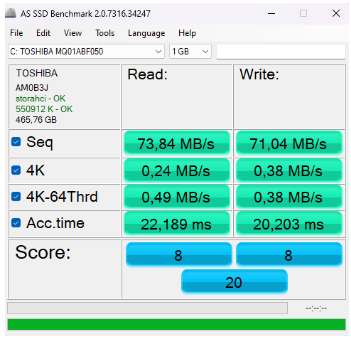
Storage subsystems often become the bottleneck in modern laptops, especially when applications generate high I/O demand. This study evaluated the performance impact of replacing a 5400 rpm HDD with an NVMe SSD in an Asus TUF FX505DU laptop. A qualitative descriptive approach was used by combining literature review, an interview with a computer technician, and controlled benchmarking on the same hardware platform. Four tools were employed: ATTO Disk Benchmark, AS SSD Benchmark, HD Tune Pro, and Cinebench 2024. The SSD demonstrated substantially higher sequential throughput and significantly lower access latency than the HDD; HD Tune Pro reported an average read rate of 660.5 MB/s for the SSD compared with 4.5 MB/s for the HDD, with access time reduced from 95.1 ms to 0.251 ms. Application-related results also improved, including a higher GPU score in Cinebench. However, some CPU-related metrics did not improve and the SSD scenario showed higher CPU utilization during storage testing, indicating that faster I/O could shift the bottleneck to computation. Overall, the results confirmed that SSD adoption markedly improved laptop responsiveness and data access performance, and it was recommended as the primary storage option for modern workloads.
Downloads
References
[2] Kominfo Kota Bogor, “Perbedaan SSD dan HDD,” Diskominfo Kota Bogor, Feb. 1, 2022. [Online]. Available: https://kominfo.kotabogor.go.id/index.php/post/single/749
[3] M. Hepisuthar and P. Sharma, “Comparative Analysis Study on SSD, HDD, and SSHD,” Turkish Journal of Computer and Mathematics Education, vol. 12, no. 3, pp. 3635–3641. [Online]. Available: https://turcomat.org/index.php/turkbilmat/article/view/1644
[4] N. Miza et al., “Metode penelitian kualitatif studi pustaka,” EDUMASPUL, vol. 6, no. 1, pp. 974–980, 2022.
[5] E. D. Kartiningrum, “Panduan penyusunan studi literatur,” 2015. [Online]. Available: https://stikesmajapahit.ac.id/lppm/wp-content/uploads/2019/04/panduan-penyusunan-studi-literatur.pdf
[6] Salmaa, “Studi literatur: Pengertian, ciri, teknik pengumpulan datanya,” Penerbit Deepublish, Mar. 17, 2023. [Online]. Available: https://penerbitdeepublish.com/studi-literatur
[7] IBM, “Hard Disk Drive (HDD) vs. Solid State Drive (SSD): What’s the Difference?,” IBM Blog, Feb. 2, 2022. [Online]. Available: https://www.ibm.com/blog/hard-disk-drive-vs-solid-state-drive/
[8] C. BasuMallick, “SSD vs. HDD: 11 Key Comparisons,” Spiceworks, Nov. 28, 2022. [Online]. Available: https://www.spiceworks.com/tech/tech-101/articles/ssd-vs-hdd/
[9] S. A. Shirke, N. Jayakumar, and S. Patil, “Design and performance analysis of modern computational storage devices: A systematic review,” Expert Systems with Applications, vol. 250, art. no. 123570, 2024, doi: 10.1016/j.eswa.2024.123570.
[10] H. He, E. Xu, S. Li, Z. Jia, S. Zheng, Y. Yu, J. Ma, and X. Liao, “When Database Meets New Storage Devices: Understanding and Exposing Performance Mismatches via Configurations,” Proceedings of the VLDB Endowment, vol. 16, no. 7, pp. 1712–1725, 2023, doi: 10.14778/3587136.3587145.
Downloads
Published
How to Cite
Issue
Section
License
Copyright (c) 2026 Ahmad Fauzan, Adly Fitra Kusuma, Yuliarman Saragih

This work is licensed under a Creative Commons Attribution 4.0 International License.