Two-Layer Fractional Frequency Reuse With Bandwidth Partitioning for 3.5 GHz 5G Urban Macrocells
DOI:
https://doi.org/10.24036/jtein.v7i1.818Keywords:
Fractional Frequency Reuse, Bandwidth partitioning, Inter-cell interference, 5GAbstract
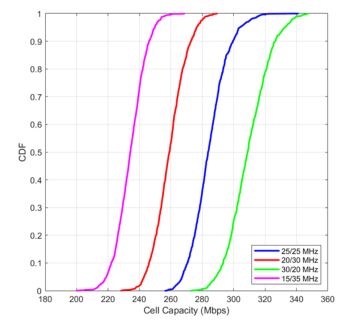
Inter-cell interference is still a major bottleneck in 3.5 GHz 5G urban macrocells, and it hits cell-edge users the hardest, leading to low SINR and unequal user throughput. This work studies a two-layer fractional frequency reuse (FFR) scheme that divides a macrocell into inner and outer regions using a fixed threshold radius, then splits a 100 MHz carrier into two separate subbands for the two regions. Performance is evaluated through Monte Carlo simulations using a 3D UMa path-loss model, realistic macro base-station EIRP, and a first-tier interference setting, where the outer region operates with reuse-3 while the inner region uses a reduced (thinned) reuse pattern. Four bandwidth splits between inner and outer regions are tested (25/25, 30/20, 20/30, and 15/35 MHz), and the comparison focuses on total cell capacity, spectral efficiency, and Jain’s fairness index. The results show a clear trade-off: giving more bandwidth to the inner region delivers the highest throughput, with the 30/20 MHz split producing cell capacity above 310 Mbps and spectral efficiency of 6.2 bit/s/Hz, but also the lowest fairness at 0.66. Shifting bandwidth toward the outer region improves fairness, reaching 0.82 for 20/30 MHz and 0.86 for 15/35 MHz, but reduces capacity to 260 Mbps and 234 Mbps and spectral efficiency to 5.2 bit/s/Hz and 4.7 bit/s/Hz. Overall, the study highlights how bandwidth partitioning should be chosen based on whether the priority is maximizing total throughput or improving fairness for cell-edge users.
Downloads
References
[2] E. Björnson, F. Kara, N. Kolomvakis, A. Kosasih, P. Ramezani, and M. B. Salman, “Enabling 6G Performance in the Upper Mid-Band by Transitioning From Massive to Gigantic MIMO,” 2024, arXiv. doi: 10.48550/ARXIV.2407.05630.
[3] K. Bechta, C. Zió?kowski, J. M. Kelner, and L. Nowosielski, “Modeling of Downlink Interference in Massive MIMO 5G Macro-Cell,” Sensors, vol. 21, no. 2, p. 597, Jan. 2021, doi: 10.3390/s21020597.
[4] T. D. Novlan, R. K. Ganti, A. Ghosh, and J. G. Andrews, “Analytical Evaluation of Fractional Frequency Reuse for Heterogeneous Cellular Networks,” IEEE Trans. Commun., vol. 60, no. 7, pp. 2029–2039, Jul. 2012, doi: 10.1109/TCOMM.2012.061112.110477.
[5] M. Seo, S.-H. Chang, J.-M. Lee, K.-H. Kim, H. Park, and S.-H. Kim, “Optimal Coverage of Full Frequency Reuse in FFR Networks in Relation to Power Scaling of a Base Station,” Sensors, vol. 23, no. 21, p. 8925, Nov. 2023, doi: 10.3390/s23218925.
[6] S. C. Lam and X. N. Tran, “Fractional Frequency Reuse in Ultra Dense Networks,” Physical Communication, vol. 48, p. 101433, Oct. 2021, doi: 10.1016/j.phycom.2021.101433.
[7] D. Lin, “Comparison of FFR+IFR and IFR Models with Different Frequency Reuse Factors in Cellular Networks,” HSET, vol. 27, pp. 575–579, Dec. 2022, doi: 10.54097/hset.v27i.3818.
[8] M. Rahman and H. Yanikomeroglu, “Enhancing cell-edge performance: a downlink dynamic interference avoidance scheme with inter-cell coordination,” IEEE Trans. Wireless Commun., vol. 9, no. 4, pp. 1414–1425, Apr. 2010, doi: 10.1109/TWC.2010.04.090256.
[9] X. Zhang et al., “Cell Edge User Capacity-Coverage Reliability Tradeoff for 5G-R Systems With Overlapped Linear Coverage,” IEEE Trans. Intell. Transport. Syst., vol. 23, no. 10, pp. 17936–17951, Oct. 2022, doi: 10.1109/TITS.2022.3174671.
[10] X. Han et al., “Flexible Spectrum Orchestration of Carrier Aggregation for 5G-Advanced,” 2023, doi: 10.48550/ARXIV.2305.15890.
[11] S.-H. Chang, H.-G. Park, S.-H. Kim, and J. P. Choi, “Study on Coverage of Full Frequency Reuse in FFR Systems Based on Outage Probability,” IEEE Trans. Commun., vol. 66, no. 11, pp. 5828–5843, Nov. 2018, doi: 10.1109/TCOMM.2018.2859326.
Downloads
Published
How to Cite
Issue
Section
License
Copyright (c) 2026 JTEIN: Jurnal Teknik Elektro Indonesia

This work is licensed under a Creative Commons Attribution 4.0 International License.